
India has emerged as a 'major power' by achieving outstanding results in economic development and social governance and its transformation as a stronger, assertive country has made it a 'new geopolitical factor', according to a commentary by a Chinese scholar in a state-run newspaper in Beijing.

It will be the first high-level meeting between the two sides after the border row escalated in eastern Ladakh in early May.
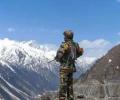
The Heron unmanned aerial vehicles are already in the Air Force, Navy, and the Army and are being used extensively at the moment by both Army surveillance and Target acquisition batteries and Air Force in the Ladakh sector.

The commanders are also expected to specifically deliberate on deployment of first batch of around six Rafale fighter jets which are expected to join the IAF's fighter fleet later this month, they said.

After a gap of over two-and-half months, India and China on Sunday held the ninth round of military talks specifically focusing on ways to move forward on the long-negotiated disengagement process in eastern Ladakh as thousands of their troops remained deployed at friction points under freezing conditions.

'However, we must implement a tit-for-tat approach -- reciprocating their conduct with precision.' 'If they demonstrate respect, we respond accordingly. If they adopt hostile positions, we mirror that hostility with equal intensity.'
China routinely objects to Indian leaders' visits to Arunachal Pradesh to buttress its stand.

China and India should put their differences on the border issue at a "proper position" in bilateral relations and stick to the "right direction" of bilateral ties, Chinese Foreign Minister Wang Yi said on Friday.
'It is a constantly evolving situation and will require deft handling at the ground level and at the highest level of military, diplomatic and political leadership,' observes Colonel S Dinny (retd), who served as Commanding Officer of an infantry battalion deployed in the Pangong Tso area.

The discussions took place on the sidelines of the G20 Foreign Ministers' Meeting.

External Affairs Minister S Jaishankar and his Chinese counterpart Wang Yi met in Moscow on Thursday amid hopes of a possible breakthrough in reducing tensions along the Line of Actual Control (LAC) in eastern Ladakh.

Mishra said the actor should learn to differentiate between the Army and cinema.
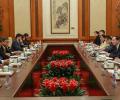
In the talks, China emphasised that the two sides should proceed from the fundamental interests of China, India and adhere to the strategic height and long-term perspective of China-India relations, the readout said.

In his meeting with Prime Minister Narendra Modi on the sidelines of the 16th BRICS Summit in the Russian city of Kazan, Xi said that China-India relations are essentially a question of how the two large developing countries and neighbours, each with a 1.4-billion-strong population, treat each other, it added.
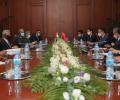
In a meeting on the sidelines of the summit of the Shanghai Cooperation Organisation (SCO) in Dushanbe on Thursday, the two foreign ministers exchanged views on the current situation in the region and agreed that military and diplomatic officials of both sides should meet again and discuss resolving the remaining issues at the earliest.

In the review meeting, Singh told the top military brass to continue to deal with the situation in eastern Ladakh and other areas with "firmness".

Corps Commander-level meeting between armies of India and China was held in Chushul on Tuesday, to resolve the ongoing dispute over Chinese aggression along the Line of Actual Control (LAC) in Eastern Ladakh area, said Indian Army Sources.

The IAF chief also said Pakistan has become a pawn of Chinese policy and its dependence on China would increase further in future. He said India needs to understand the interplay of some major events in its vicinity that would impact the security scenario of the region.

His attack on the government came days after Indian Army personnel clashed with Chinese soldiers in the Tawang sector in Arunachal Pradesh.
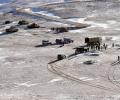
India and China to hold the 11th round of corps commander-level talks at Chushul in eastern Ladakh at 10.30 am on Friday that is expected to focus on disengagement of troops in remaining friction points, sources within the Indian Army said.
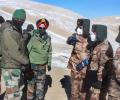
'China and India have encountered some setbacks in recent years which do not serve the fundamental interests of the two countries and the two peoples'

The ministry's year-end review is silent on the continued occupation by Chinese troops of territory that India has always claimed and patrolled.
The sources also said another round of military talks between the two sides on Wednesday to defuse tensions in the area remained inconclusive. The talks lasted nearly seven hours.
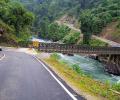
The United States has recognised that territory (Arunachal Pradesh) for a long time (as an integral part of India), White House Press Secretary Karine Jean-Pierre said.
Multiple rounds of talks have failed to yield any significant result in defusing border tensions. The last round of Corps Commander-level talks between both countries were held on November 6, 2020 in Chushul in Eastern Ladakh.
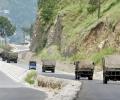
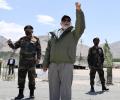
Sources said the work has already started on this project and the new road will connect Manali with Leh near Nimu where Prime Minister Narendra Modi had recently visited during the ongoing conflict with China.

The two sides are also expected to finalise a roadmap for restoration of peace and tranquility in the high-altitude region that witnessed an eight-week bitter standoff between the troops of the two countries.

The use of the strategic road by the Indian security forces from Leh has helped in reducing the travel time between Leh and DBO to six hours.

The disengagement process from both the north and south banks of Pangong Lake was completed by the two nations and further disengagement is underway at other friction points.

The meeting will take place in Chushul sector on the Indian side of Line of Actual Control.

The Army said it was also highlighted that completion of disengagement in other areas would pave the way for the two sides to consider de-escalation of forces and ensure full restoration of peace and tranquillity and enable progress in bilateral relations.

The sources said the soldier was handed back to China at the Chushul-Moldo border point in eastern Ladakh at 10.10 am.

The Jaishankar-Wang talks came amid the dragging border row in eastern Ladakh that entered its fifth year in May.
The Chinese military has already completed moving back its troops from the face-off sites in Galwan Valley, Gogra and Hot Springs in line with the first phase of the disengagement process from the friction points on the LAC in eastern Ladakh, sources said. The main focus now shifts to Pangong Tso. India has been insisting that China must withdraw its forces from areas between Finger Four and Eight.
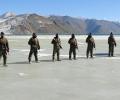
"Against such background, the words and deeds of relevant important military and government officials and military deployments should be conducive to deescalating and cooling down the situation, and to enhancing mutual trust, rather than the opposite", the spokesman said.
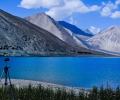
According to sources, the post at which the Chinese army has put up loudspeakers is under 24x7 constant watch by Indian soldiers and it is possible that the Chinese might be indulging in such drama to distract our troops or perhaps just relieve the pressure.

Asked about the recent meeting between Modi and Xi, and if Russia had any role in it, Alipov said, "We have not played any role in it, but we are happy that it took place in Kazan... We wholeheartedly welcome the meeting."
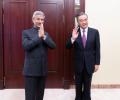
'We stress that the boundary issue shall not be linked with the overall bilateral relations. That is an important experience we have gathered through many years' effort to keep the ties moving forward

External Affairs Minister S Jaishankar on Saturday credited the breakthrough agreement with China on patrolling along the Line of Actual Control to the military which worked in 'very very unimaginable' conditions and deft diplomacy.

They said the Indian Army has further bolstered its presence around the Southern Bank area of Pangong lake by deploying additional troops and bringing in more weaponry including tanks and anti tank guided missiles.
